Showing posts with label Guyana. Show all posts

Back to Saddle Mountain

Probably the nicest place I have been to in Guyana is Saddle Mountain ranch in the South Rupununi. I went just before Christmas and had a great time, so as Rodeo was coming up just down the road in Lethem, a friend and I decided to go for 4 nights to the ranch before Rodeo. Both of us are leaving in the next couple of weeks so it was a good final holiday.


We began by getting on the Intraserv bus from Jerry's bar at around 9pm, for around a 13 hour trip overnight to Lethem. In fact it seemed to be a popular bus as I met 8 different people that I already knew travelling at the same time! A constant reminder of the small size of Guyana's population. The road to Linden, maybe an hour or two from Georgetown, is paved, followed by red dirt road which is maintained to some degree but pretty bumpy. Anyway on the road to Linden the windscreen broke and had a massive hole in it. It was already breezy in the bus but things really got going. I was wondering how the journey might turn out (could they really drive all that way with half a windscreen?) when we stopped alongside a bus coming back to Georgetown and swapped.

Suprisingly, everything went well, all our bags ended up in the right bus, and as far as I can gather all the people too. I felt a bit sorry for those who had probably been on a good working bus for 12 hours then having to change over, delay their journey, get in an extremely blowy bus and were very nearly home. As a little extra entertainment, the bus broke down at the final immigration point so we had to get a taxi into Lethem proper.


Onto the ranch; as with last time the house was fantastic, and it was quite refreshing not to have proper power or internet, but we had enough of the basics (beds, proper bathroom) to be comfortable. This time I had a horse called Thunder, who really loved to run fast. This was a little frightening for me as I never quite graduated beyond holding on for dear life but it was great fun. One afternoon we went off to round up cattle which was good, I did this last time but I got left behind so never managed to do much rounding up. This time however, with Thunder taking me around, it was really fun. There's something about herding cattle, particularly racing off after one that decided to break loose.

Later that day we had a go at calf roping - apparently an event at rodeo where a man and a woman team up, the man has to rope a calf and hold it still enough for the woman to take a ribbon off its tail. Whilst my lasso-ing wasn't so hot, I think we could have held our own, maybe. Fortunately the event didn't take place at Rodeo so I wasn't tested.

Three pigs (I believe) had given birth to 24 piglets in the past few days which were very cute. Despite not being a fan of cuteness sites I have gone so far as to post a video of some piglets nibbling my foot:


They were quite funny with their little oinks and ran away whenever they were chased. However if their mum was around they calmed down a bit which is why they got so close to me.

As always the food was excellent with three big meals a day which are absolutely what is needed when out riding and enjoying a little rum in the evening. I hope I will return someday.

Thoughts so far

As I come towards my last 5 weeks in Guyana I thought I'd record a few thoughts about my experience so far. There's no doubt that this was worth doing - for me at least. I've had a whole load of experiences and challenges that I would never have otherwise had, and had a lot of good times. As time goes on however I often feel like the work I do is a little unorganised and not as effective as it could be. I came here essentially without a boss or a remit - a mercenary volunteer if you like, which is actually quite challenging. If I want to do some work, I have to create it, and this leaves me open a little to the risk of doing work for the sake of doing it, rather than if there is a real need. One of my aims in coming out here is identifying a possible placement for a future volunteer, but as yet I am not sure how this will materialise. There is certainly plenty of need in Guyana, but there does need to be a good structure to justify sending someone thousands of miles to do something. My own case was not so bad as firstly I did encounter some help at the start, and secondly I have personal reasons for being here. I think if I'd just turned up without much to do and no particular link to the country it would have been a lot harder.

The fun side - traveling, going to parties, and so on has been great. I will definitely miss the Guyanese evenings out on someone's balcony (sadly I don't have one) and the fun times I've had with other volunteer/development types here. The reason I sometimes feel disillusioned is that the thing I came here to do - work in IT (too broad a remit really) is entirely contingent on what I do, and so can be quite unsatisfying if I don't get much done. Party time is great, but only if there's good work to justify it. A significant amount of this is my responsibility - I'm responsible for making sure I get things done during the day, and finding things to do in the first place, but that doesn't mean it's easy. Nevertheless, facing such challenges will have been a great experience and hopefully will serve me well in the future.

In these final weeks I have now set up three four-part IT courses which I will be delivering to teachers at Mercy Wings (Beginner's IT, Intermediate IT and Using IT for teaching - do I know anything about this? I'd better learn quickly!) and I will be making sure everything at Saints is robust and well documented so it can continue to run well in the future.

Across the Essequibo and Mashramani

Once again it's been a while since my last post, and now with just over 7 weeks left in the country I suppose there won't be that many more. Anyway, the past couple of weeks have seen a lot of activity - a trip to a beautiful house across the Essequibo, Mashramani and plenty of partying inbetween. There's a bar in Georgetown called Jerries which is open pretty much all of the time - visits at 4 or 5 in the morning are always entertaining as it is the "wash-down" place to be, so I've been spending a bit of time there recently.


Last weekend a group of 15 hired a bus and headed West, across the Demerara (my first crossing of the harbour bridge) to Parika which is a major crossing point over the Essequibo. The Essequibo is in parts a massive river, and I am told is 26 miles wide at its mouth. Anyway we boarded a boat and took about an hour-long trip up and across the river to Bartica, a mining town a little inland. The boat then took us 1 minute further up the river to Bidarabu, a big wooden house with five big bedrooms, big verandas, a swimming pool and a private beach. Well I say private, when I went down there in the morning a local woman was having a wash so I had to make myself scarce pretty quickly but essentially it is a secluded spot - perfect for a party!


It felt like something from a Hollywood film; a pool party with seemingly endless food, rum, party games and splashing around in a swimming pool. I know one of the biggest things I will miss about Guyana will be sitting outside in the warm weather. The group was great fun too - a significant number are development workers, who are much more glamorous than volunteers. I get the impression that there's an ex-pat hierarchy, from volunteer types (like me) at the very bottom, living in basic housing and counting cash, right through development workers with housing allowances and all the way up to diplomats with swimming pools and guards. Anyway this crowd is particularly good fun and our weekend was a non-stop party although some people balked when I cracked out the rum again the following morning. Hair of the dog I suppose...

The following Tuesday was Mashramani - Guyana's carnival. I went on the road at about midday and it seemed that every square meter lining the road had someone with a cooler or a stand selling beer and food. There were barbeques everywhere and floats from different groups, organisations and political parties. It was very jolly, although it seemed to take a long time (sometimes an hour and a half) between floats. The first part of the day was quite overcast but when the sun came out in the afternoon it got seriously hot. In the evening a small group of us went to sit by the sea wall and watch the sun set which was nice, and very busy. There were cars and speakers playing loud music everywhere which meant there were people bouncing and dancing everywhere - in Guyana, if there's music everyone bounces.


That evening we went to a Machel Montano concert, who is apparently a leading Soca star from Trinidad. It was great fun - although the support act didn't start until past midnight and he didn't come on until 2am, and he was only on for about 90 minutes. Still, armed with some brown rum we had a good group and it was a great show.

So after all this partying it's time to calm down a little - although it's Paguah on Monday so another day off and a party at someone's house. I'm also organising a final trip down to the Rupununi for Rodeo which is at Easter weekend. Still, I have also spent some time at Mercy Wings school recently and their computers are now in good condition and next I hope to help another VSO set up some literacy software on there. Saints is doing well too - I'm moving towards wrapping things up and leaving it to improve without me.


Until next time...

Lethem and Saddle Mountain

A couple of days ago I got back from spending about a week in Lethem and the South Rupununi which is on the Guyana-Brazil border. Someone told me it would be like a different continent down there - and it is. I travelled down on a plane - my first small plane trip on a 10 seater. It was nice to see Georgetown from the air, after which we flew over dense bush for a while, which breaks out into Savannah and endless plains.

Once we arrived in Lethem we checked into the hotel and took a look around. It has a lot of Brazilian influence - most signs are in English and Portuguese; there are lots of shops selling shoes and t-shirts which are pretty quiet during the week but are flooded with Brazilians at the weekend! After an evening eating Brazilian kebabs and drinking plenty of beer we headed to bed. The hotel had air conditioning and hot water - I had my first hot shower since I left Barbados. Lethem is primarily an Amerindian town and has a very different feel to Georgetown; as an outsider you feel very safe walking around, even at night, and there is plenty of space and very little mess. It's also a lot cooler as there is always a breeze accross the Savannah.

Our party consisted of myself, a Canadian VSO, two of his friends and one chap in his 50s from the UK who goes travelling in South America every year. This chap was a stereotypical colonial complete with bushy handlebar moustache and was never not in his explorer gear - outdoor trousers, shirt and full brimmed hat. On our first full day in Lethem we got someone to drive us to Moco Moco falls, a derelict hydroelectric power station originally put in by the Chinese government which fell into disrepair after a landslide. There were 975 steps to the top, although many of the steps were broken or simply washed away so a fair amount of scrambling was required. It took about 90 minutes to get up with a few stops and time taken to scramble up rocks, but it was worth it and we spent a while enjoying swimming in the rock pools and waterfalls at the top before heading back down. On the way home our driver Wayne took us to see his allegedly 110 year old Grandfather on a small farm and we were given some Kari (phonetically spelt) which is an alcoholic drink made from Cassava. It had lumps in it and was a bit like a very sharp-tasting cider and potato soup.
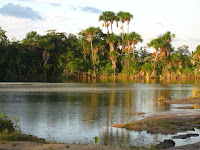
The following day we drove to Saddle Mountain Ranch which was the focus of our trip. There we spend four days riding horses, rounding up cattle, eating, sleeping and drinking. The first day we visited a little creek there which was a beatiful place to swim and wash clothes, followed by a big meal (our hostess cooked us three big meals a day which were all excellent) and settled in with some beer and rum. There isn't any electricity, phone or mobile coverage there so things were quite basic, although a small solar-charged battery provided lights in the evening and there was a water pump in a well so we had running water in the house. It was quite nice to be so remote - and you can see all the stars at night. Having said that, getting home has been nice as I'm not so good at hand-washing clothes to the extent of them not looking any cleaner than when they went in.

As someone who has only done a couple of pony rides before, riding took a little while to get a hand on but was pretty easy to get the hang of. Saddle sores were a bit of an issue for everyone but we just had to man up and get on with it. My horse was called Lightning and he was quite good natured. He wasn't so keen on galloping though, and to get him to go fast he needed a little go with the riding crop. The thing is, none of us were confident enough to ride hands-free, so one hand is used holding onto the saddle for dear life, the other to the riding crop. This is fine unless you need to steer; and horses aren't so smart so they'll happily dash under a low branch without any regard to the fact that you will fall off. As a result I had to do a bit of shuffling of hand whilst running but fortunately managed not to fall off despite a few near misses.

One morning we got up early (after a lot of rum the night before and having to carry our moustached friend to bed!) and rode out to find some of the ranch's cattle. They are let out to graze most of the time but have to be brought in to be branded, castrated and so on. This was a great outing for about 4 hours and we travelled a long way over the Savannah herding cattle all the way home. The other interesting session was castrating about 8 young bulls - there were maybe 50 cows in the corral by the Ranch so we had to lassoo, then pull in, then knock over and hold on the floor every eligible bull whilst Tommy the ranch owner came over with his knife and things got a bit gruesome. Watching the first was pretty nasty but after a few it was ok, and I was involved in holding the head so the bull didn't struggle, and in one case had to pull its tail to turn it over.


On Christmas Eve we headed back to Lethem and spent Christmas day at someone's house playing monopoly, drinking and having Christmas dinner. That night we went to the local nightclub which is essentially someone's garden but was quite fun. I got a bit lost on the way home unfortunately but someone gave me a lift on the back of their scooter which was pretty fun. There aren't many street lights so naturally things look very different at night!

We travelled back to Georgetown on a minibus which was not too bad, except the bus we started on kept stopping as the engine kept overheating. We were then transferred onto another which was ok except they guy drove very fast. This was good for getting home (the trip still took 11 hours) but bad for getting back alive. Much of the road was through the jungle - and was in surprisingly good condition, although there was the occasional tree fallen which had to be navigated around.

My little camera served me well on the trip and I took loads of photos - you can see some of them here. All in all, it was a great trip - riding on the Savannah is a truly wonderful experience. I hope to go to Lethem for the Easter Rodeo which is apparently the place to be in Guyana which I will look forward to.


Until next time...

Guyana's Hidden Economy

There seems to be a paradox in Guyana between wages and the cost of living. People are paid very little but the cost of living does not reflect this. A policeman earns around 40,000 GYD, which is around £120. The cost of renting a reasonable flat or apartment starts at 50,000 GYD, around £150.

It is not just the policemen however, I am told that most jobs pay very little. Teachers earn an average annual salary of 500,000 GYD after tax which is £1500. This sounds ridiculous compared to say, a teacher in the UK earning £25,000 which here would be 8.25 million GYD.

So how is the wage rate so low despite the cost of living, and how does everyone get by? I am becoming aware of what I would say is a hidden economy. There are a number of ways that Guyanese people make the difference: illegal drugs (smuggling out to the US and Europe) apparently account for 60% of the economy and corruption is a real problem.

Legitimate earnings also make the difference. Private businesses can do quite well - food sellers on the street for example can turn a profit that will cover their living expenses. Those fortunate enough to be employed by foreign companies of agencies get paid foreign salaries and can live very well indeed. The main thing however, is money coming from abroad. Someone told me that the recordable (through banks, MoneyGram etc) influx of money from abroad is 450 million USD per year. Most Guyanese have families abroad, many of whom send money back. If you consider the population to be 750,000 $450 million is a huge amount of money to come in (and this doesn't cover cash or other methods of remittance).

One of the biggest problems, in my opinion, is the low wage rate. Many jobs provide less income than is required to live unless you own your house or live with your parents. As a result fraud, theft and corruption are almost understandable to make ends meet. At the same time, the hidden economy seems to bridge the difference - if people were really paid too little the wage rate would increase. It seems like a perpetual situation of people "hustling" to get by.

I have been told that most educated people (particularly teachers) will all have applications to leave the country and are waiting for the opportunity, and I don't blame them. You could teach in the UK for a year and return very wealthy, or stay in Guyana and earn less than it costs to live.

Guyana would be a desperately poor country if it wasn't for the international diaspora, reportedly larger than the resident population. Their money props up, but perhaps also confounds, the economy.

This is my opinion at the moment, but I am sure I have more to learn...

Georgetown

Early on Saturday morning I headed off to the airport to leave Barbados and head for Guyana. The plane was a small 50-seater Dash-8 turboprop aircraft. It was my first time on such a small aircraft - it felt more like a bus than a plane. The engines were pretty noisy and at points it was a little like having your head inside a tractor engine. After an hour or so of flight I caught a glimpse of the South American coastline. The Caribbean blue sea abruptly stopped and was replaced by muddy brown, caused I think by the huge rivers that flow into the sea there. We flew past the Essequibo river which is very wide and has some huge islands in it.

The feature that struck me the most however was the jungle. Guyana has huge amounts of jungle, and as we flew in apart from a few roads and rivers there was green as far as the eye could see. Once the plane landed landed I collected my bag and was picked up by a British ex-pat who drove me into Georgetown. The feel was very different to Barbados - it was very exciting to have finally made it to Guyana.


On the way in we stopped off, changed some money and I purchased a Guyanese sim card for my phone. There are about 330 dollars to the pound here, and they tend to circulate in 1000 dollar notes. Given that this is about £3, to carry any amount of money involves quite a big wad. Georgetown is very different to Barbados in a number of ways. Firstly, Barbados is a primarily black population, and someone of my complexion immediately stands out as a tourist. Guyana is far more mixed, and whilst most are Indian or African in descent, there are a number of Portuguese, Chinese and any number of combinations. As a result, I don't really stand out. Secondly, the atmosphere is very different - this is not a tourist place, and so there aren't many people out spying for tourists to get their attention. This all makes for a quite friendly feel. I dropped my stuff off at the place I am staying - with a retired teacher who has worked at my link school, St. Stanislaus. Almost immediately we went to a small cafe place where I was laughed at for having chicken curry and noodles but it was quite tasty. Another chap had what they call souse - this can be made with a number of things but one of the favourites is cow face. That's right, cow face. It's a slow cooked stewy broth kind of with bits of meat in - I'll have to try it.


We spent the afternoon going to bars, drinking vodka with water and lime which is not bad at all. We met up with a few more people including a chap who owned a club where we went later on and had some food. The atmostphere is quite unique here - some of the bars are houses on normal residential streets with most people sitting outside. We had a driver who took us from place to place which is a bit different to doing a bar crawl in Durham. Having said that, it gets dark early and you probably want a driver just to be safe.

The accent is strong here and will take a bit of getting used to. I don't stand out until I open my mouth - there have been a few jokes at my expense; I imagine I am a very stereotypical English boy. Since I have only been here a few hours so I haven't really got my bearings at all. I am quite central though as it's just two minutes down the road to St. Georges Cathedral, until recently the tallest wooden structure in the world. This afternoon we are driving off to a place along the coast for some duck curry. On Monday I hope to visit St. Stanislaus College where I will be based. The reaction of some people to my project has been interesting, apparently I'm in for a shock. Watch this space....


A short tour of the apartment, introduced by the landlady's dog...

Henry in Guyana!


Ivan Chin, born 1923 in Georgetown, Guyana came to the UK during the Second World War after signing up for the RAF. By the time he arrived it was all over-however he remained in the UK, staying in the RAF for a while then doing a government-sponsored business course. Later, he did a number of things including running a steel band, working for the Foreign Office and having a few children, after which I was born followed by my brother Dominic. Of mixed African and Chinese descent he met my British mother which explains to some degree my ambiguous ethnicity. Sadly, he died of cancer in 1994 aged 71.

In September 2008 I began planning what would become the adventure I am about to depart for: a six month volunteering trip to Guyana. I decided that after a number of years of following a fairly standard path through school and university it was time for a serious adventure, and so the project was born.

Having never been to Guyana (and to this day knowing very little about it), it seemed like the perfect place to go. Guyana is a little-understood developing country (the number of people who have asked about my trip to Ghana...), former British colony and the only English speaking country in South America. A little smaller than Britain, it has a population of around 750,000 with a mix of predominantly Amerindian, African and Indian ethnicities, plus significant Chinese and Portuguese communities as well. Culturally it is considered part of the Caribbean.

I began working with a small charity in London called the Daneford Trust, who whilst advertising it had projects in Guyana had yet to actually set one up! As a result I am now the guinea pig which I am very happy to be. I chose a volunteering project over classic "travelling" because I wanted the opportunity to live in and understand the country rather than just passing through. Hopefully six months will be long enough to do this (although I hear that such adventures can be addictive).

Fundraising went well with a number of contributors making a big difference to my project. Planning the project however was a little more tricky. With no (known) family there and few links, it took a long time for anything to materialise. However in the past few weeks a lot has happened; I have been put in touch with St. Stanislaus College in Georgetown (the capital) and I'm heading out there to help with their IT teaching and infra-structure. To be honest I won't know exactly what will happen there until I arrive, however they teach Computer Science at A level and have a broadband internet, so things must be quite good. I guess I'll find out when I get there!

This blog will serve as a log and a way of communicating how my adventures go. I plan to update it at least every week or two. Watch this space...